
How IPL Style Auction Software Brings Pro-Level Drama to Your Tournament
A practical guide to running an IPL style player auction for your league, and how AuctionBall handles bidding, budgets, and team building without the chaos of spreadsheets.
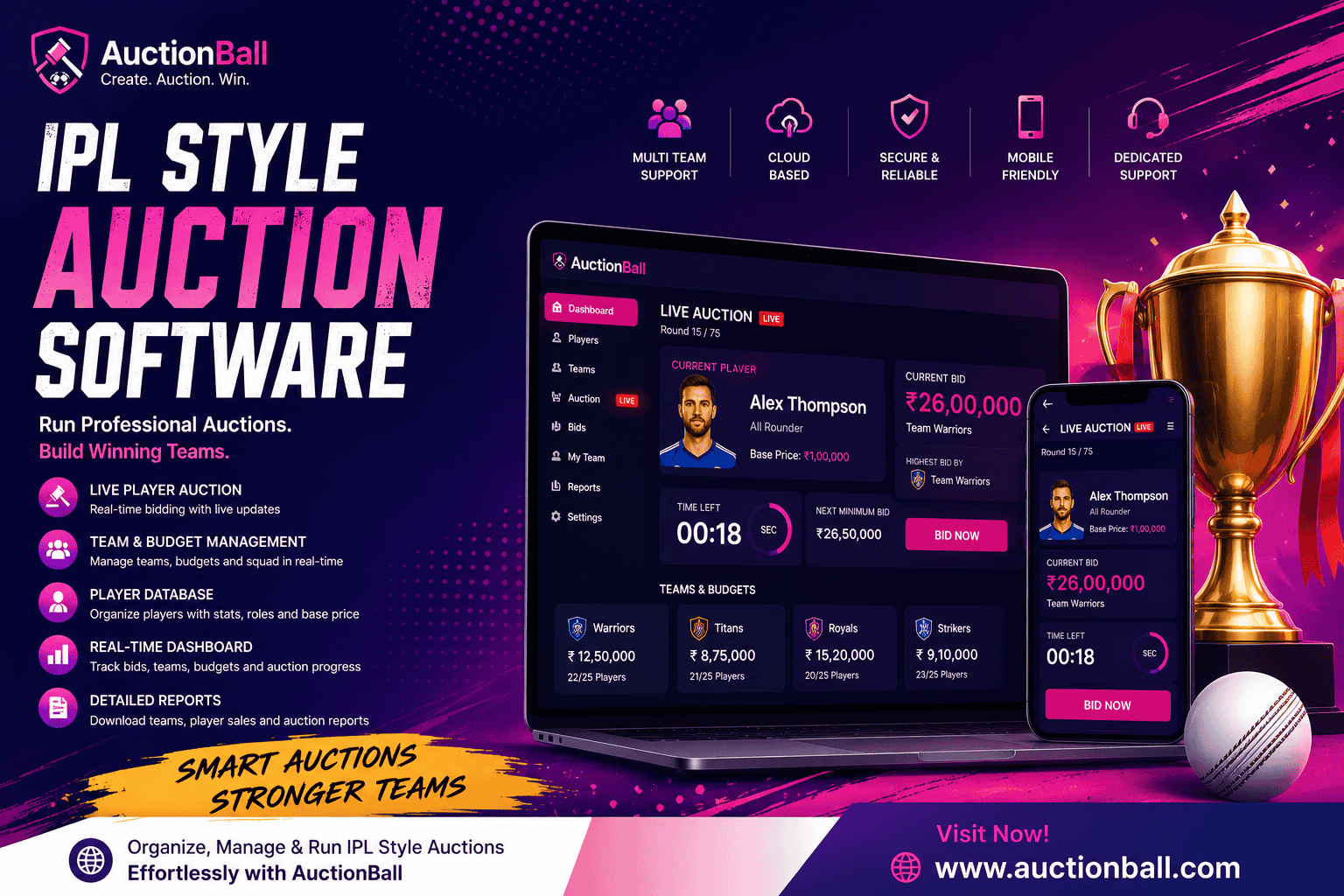
Anyone who has watched the IPL auction knows the appeal. The countdown, the rising bids, the moment a team blows past its budget for a player it simply refuses to lose. That tension is half the fun. The trouble starts when you try to recreate it for your own local league with a projector, a printed player list, and someone shouting numbers across the room.
If you organize cricket leagues, corporate tournaments, or weekend sports events, you have probably tried to run a player auction at least once. And you have probably watched it fall apart somewhere around the third bidding war, when nobody can remember how much money Team Red has left. IPL style auction software exists to fix exactly that. This piece walks through what these auctions actually require, where manual methods break down, and how AuctionBall maps to the real IPL format feature by feature.
What makes an IPL style auction different
A casual draft is one thing. An IPL style auction is structured, and that structure is what creates the drama. A few things define it:
- A fixed purse per team. Every franchise gets the same budget and has to build a full squad within it.
- A base price for each player. Bidding starts from a set floor, not from zero.
- Live competitive bidding. Teams raise against each other in increments until only one is left standing.
- Squad rules. Minimum and maximum player counts, overseas caps, and role requirements like a set number of bowlers or wicketkeepers.
- Unsold and re-auction rounds. Players who do not sell go back into the pool for a second pass.
Miss any one of these and the event loses its shape. A team might overspend on the first three picks and field a half-empty squad. Or two captains might argue over who bid first because there was no clear record. The format only works when every rule is enforced consistently and in real time.
Why spreadsheets and shouting do not scale
Plenty of organizers start with a shared spreadsheet. It works for ten players. By player number forty, with eight teams bidding, it collapses. Someone forgets to deduct a winning bid. A captain claims a price that was never agreed. The screen everyone is watching lags two players behind.
The deeper problem is trust. Auctions involve money, even if it is play money, and people care intensely about fairness. When the source of truth is a laptop that one person controls, every close call becomes a dispute. Good IPL style auction software removes those disputes by making the rules automatic and the state visible to everyone at once.
AuctionBall features mapped to the IPL format
AuctionBall was built specifically to mirror the IPL auction experience, so the mapping is fairly direct. Here is how the main features line up with what you actually need on auction day.
Team purses and live budget tracking
You set a starting purse for every team, and AuctionBall tracks the remaining balance after each winning bid automatically. Just like the real auction, a franchise cannot bid beyond what it can afford. The system blocks an over-budget bid before it happens, which means no awkward reversals after a captain realizes they cannot pay.
This also enables the smarter strategy the IPL is known for. Teams can see exactly how much breathing room rivals have left, so the late rounds become a chess match of who can still afford the remaining talent.
Player pools with base prices and categories
Before the event, you upload your player list with base prices and group them into sets, the same way the IPL splits players into marquee, capped, uncapped, and specialist categories. You might run a batters set first, then bowlers, then all-rounders. AuctionBall lets you sequence these pools so the auction flows in a logical order rather than jumping around randomly.
Live bidding with clear increments
The heart of any auction is the bidding itself. AuctionBall handles bid increments so a raise always lands on a clean, agreed step rather than a messy odd number someone has to calculate on the spot. The current bid, the leading team, and the player on the block all stay front and center on the display.
The single biggest improvement over manual auctions is that everyone in the room is looking at the same screen, updated instantly. There is no debate about who bid last because the system shows it.
Unsold players and re-auction rounds
Not every player sells on the first attempt, and that is fine. AuctionBall marks unsold players and lets you bring them back into a later round, exactly like the IPL's accelerated process near the end. Teams that held back budget early can swoop in for value picks in the second pass, which keeps even the closing stretch of the auction interesting.
Squad composition rules
You can define how many players each team must have, set caps on certain categories, and limit specific roles. If your league restricts each squad to two overseas players or requires at least one wicketkeeper, AuctionBall enforces it so no team accidentally ends up with an illegal lineup. This is the kind of rule that is nearly impossible to police by hand once the room gets loud.
A presentation view for the audience
The IPL auction is a spectacle, and your event can borrow some of that energy. AuctionBall includes a display mode you can put on a big screen so spectators, players, and team owners all follow along. Watching your own name flash up with a rising price is a genuinely fun moment, and it makes the whole event feel more legitimate.
Final squad summaries and exports
When the dust settles, you need a clean record of who went where and for how much. AuctionBall generates squad-by-squad summaries you can share immediately, so captains walk away with their roster confirmed and you have a paper trail if anyone has questions later.
Running a smooth auction: practical advice
Software solves the mechanics, but the event still depends on preparation. A few things consistently separate a tight auction from a chaotic one.
- Finalize the player list early. Last-minute additions and missing base prices cause more delays than anything else. Lock your pool a day before.
- Set realistic base prices. If every player has a high floor, budgets evaporate fast and the back half of your pool goes unsold. Spread the values so there are bargains to chase late.
- Brief the captains on the rules. Walk through the purse, increments, and squad caps before bidding starts. Five minutes here saves twenty minutes of arguments later.
- Do a quick dry run. Auction two or three test players so everyone understands the flow before real money is on the table.
- Have one clear auctioneer. Even with software running the numbers, a single person should call the room, confirm sales, and keep the pace lively.
The goal is to let the technology handle accuracy while a human keeps the energy up. AuctionBall takes care of the budgets, the increments, and the squad limits so the auctioneer can focus on what they do best, which is building excitement.
Who benefits most from this
Community cricket leagues are the obvious fit, but the same format works for corporate sports days, college tournaments, fantasy-style draft events, and even non-cricket leagues that want a structured way to build balanced teams. Anywhere you have a pool of participants, a set of teams, and a need to distribute talent fairly, an IPL style auction adds both fairness and theater.
The fairness matters more than people expect. When teams build their squads through open bidding under the same budget, nobody can later claim the draft was rigged. The result is visible, the rules were equal, and the squads are balanced by design rather than by negotiation.
Bringing the IPL experience to your league
You do not need a television production crew to capture what makes the IPL auction compelling. You need consistent rules, a single source of truth, live budgets, and a screen everyone can watch. IPL style auction software packages all of that into a tool that runs the event for you while you run the room.
AuctionBall was designed around this exact format, so the features you read about above are not workarounds, they are the core of the product. If you have struggled through a spreadsheet auction in the past, the difference on your next event day is hard to overstate. The bidding stays clean, the math stays correct, and the drama, the part everyone actually came for, finally gets to take center stage.